
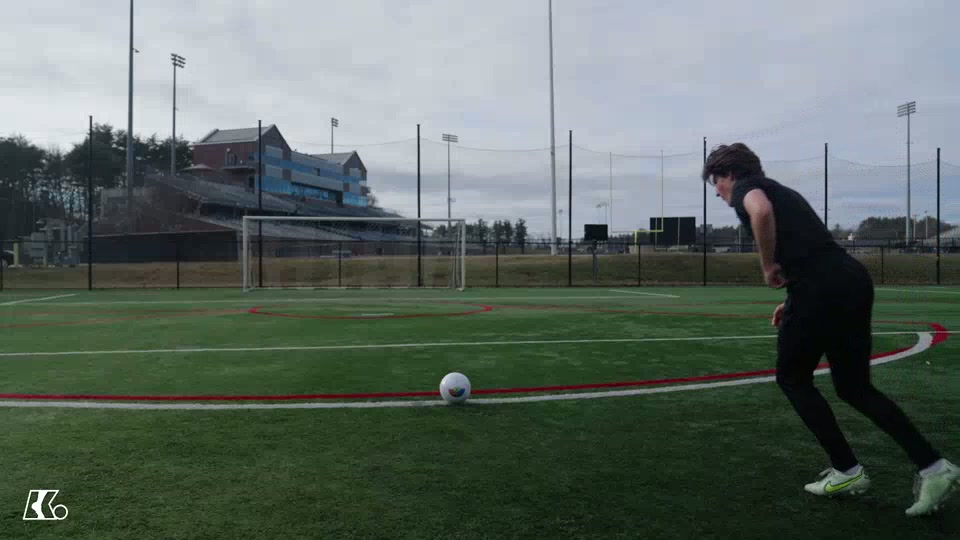
How do you strike a soccer ball cleanly?
Pick the foot surface for the job, plant your support foot beside the ball, lock the ankle of your kicking foot and swing smoothly through the ball. Start at modest effort, aim at one clear target, and change one cue at a time instead of chasing power.
You know the feeling: one ball leaves your foot solid and true, the next skids off awkwardly. Better ball contact changes everything, and it isn't about kicking harder. It's about making the ball do what you meant, with a movement you can repeat.
Start with an ordinary ball, a safe target and comfortable effort. Film a few attempts on your phone and you'll spot patterns you miss in real time.
What clean contact means
Clean means solid, repeatable contact that suits the pass or shot. A soft inside-foot pass can be cleaner than a wild, thumping drive. Judge it by feel, starting direction and where the ball arrives, not by how loud it sounds.
The "sweet spot" isn't one magic patch on the ball. It's the match between your foot surface, where you hit the ball and your swing. A straight drive, a bent free kick and a cushioned pass each need a different match, so decide what the ball should do first.
Impact, direction and spin
At impact the ball squashes against your foot for a split second and takes on its new direction. Where you hit it and which way your foot is moving decide how it launches and whether it spins. A firm striking surface makes that repeatable.
Hit through the center and the ball travels straight. Hit off center and it starts to rotate; in the air, that spin bends its path (the Magnus effect).
Spin you wanted is technique. Spin you didn't want is a clue. Compare the result with what you intended before calling it a mishit.
Choose your foot surface
- Instep / laces
- The firm upper part of the foot is commonly used for driven passes and shots. Point the toes comfortably down to present that surface, with a stable ankle. Keep enough clearance to miss the turf.
- Inside foot
- Open the hip enough to present the broad medial surface. A comfortably raised toe and firm ankle help expose it for controlled passing. Turn from the hip, not just the knee.
- Outside foot
- The lateral surface can redirect passes or help create a deliberate outside-foot bend. Learn straight contact first, then add it.
"Lock your ankle" means keep the foot firm through impact, not tense your whole body. If a position hurts, stop.
- Laces / instep
- Firm upper surface, commonly used for driven strikes.
- Inside edge
- Broad medial surface, useful for controlled passes.
- Outside edge
- Lateral surface, useful for selected angled or bending strikes.
- Ball landmarks
- Hit the center for a straight strike. Off-center contact adds spin, which is a mishit only if you didn't mean it.
Build a balanced strike
Take a short, unhurried approach that gives your foot room to swing. A slight angle helps a laces strike; an inside-foot pass needs space to open the foot.
Plant beside the ball with the support foot pointing where you want the ball to start. Too close crowds the swing; too far makes you reach.
Keep your head steady through impact and use your arms for balance. For a low drive, don't lean back. Let the swing carry on naturally: the finish shows how good the movement was.
- Support foot
- Land beside the ball with enough room to swing comfortably.
- Strike and starting line
- Use a smooth approach, then continue naturally through the intended direction.
- Adjust to you
- Spacing changes with body size, foot surface and the strike you want. Mirror it for the left foot.
Five progressive drills
Warm up first, use an age-appropriate ball and keep people out of the lane. Beginners can shorten every distance below.
Drill 1:One-step contact reset
- Setup
- Place a stationary ball in front of a broad target, about 4–6 metres away. Take one comfortable step into an inside-foot pass.
- Repetitions
- Make two sets of five per foot, retrieving and resetting between attempts.
- Coaching cue
- Present a firm surface, contact centrally and finish balanced.
- Correction / progression
- If you stab with the toes, shorten the step and open the foot earlier. Progress only when contact feels repeatable.
Drill 2:Laces without the power chase
- Setup
- Use a clear lane toward a broad goal zone or safe net. Start close enough to reach it at modest effort with a stationary ball.
- Repetitions
- Try two sets of five laces strikes with your preferred foot, then five gentle weaker-foot attempts.
- Coaching cue
- Toes comfortably down, support beside the ball, smooth swing through it.
- Correction / progression
- If the toe catches turf or contact feels cramped, adjust support spacing and reduce effort. Add distance before maximum speed.
Drill 3:Gate and usable arrival
- Setup
- Create a two-cone gate about 2 metres wide, 6–8 metres away. Pass through it to a partner or safe receiving area.
- Repetitions
- Attempt ten passes per foot; count gate hits and note usable weight.
- Coaching cue
- Choose the inside surface deliberately and reset your support foot.
- Correction / progression
- For repeated side misses, check surface orientation before swinging harder. Narrow the gate only after solid contact improves.
Drill 4:First touch into your strike
- Setup
- Roll the ball gently ahead, settle it into comfortable space, then pass or strike toward the same broad target.
- Repetitions
- Make two sets of five attempts, alternating feet if controlled.
- Coaching cue
- Let the first touch create room; arrive balanced rather than reaching.
- Correction / progression
- If you chase and shank, slow the roll and take an extra settling touch. Progress to a gentle partner feed, not a faster scramble.
Drill 5:Straight versus intentional spin
- Setup
- From one stationary-ball mark, use a clear target lane. Alternate a controlled straight strike with a gentle, purposeful inside-foot bend.
- Repetitions
- Make five pairs with the comfortable foot; try the other foot only at manageable effort.
- Coaching cue
- Name the intended flight before each attempt. Compare starting line and bend, not just the final landing.
- Correction / progression
- If both strikes slice unpredictably, return to the straight-contact drill. Never force an ankle or knee twist to manufacture curl.
Troubleshoot your mishits
Look at several attempts before changing anything. Here's what to check first.
- Unplanned toe-pokes
- Check whether you are reaching or rushing. Shorten the approach and deliberately present the intended surface before impact.
- Shanks
- Contact may be drifting toward the toe or edge. Reduce effort, create swing space and return to stationary-ball repetitions.
- Slices
- For an intended straight strike, inspect surface orientation and whether the swing cuts across the ball. Check the starting line on video.
- Over the bar
- Check backward lean, plant position and whether contact is too low for the intended drive. Lower effort and practice a broad low target, changing one cue.
- Weak or wobbly strikes
- Inspect ankle stability, interrupted swing and inconsistent contact. Check the ball's inflation too.
Use it across your game
For passes, judge clean contact by direction and usable weight. Driven balls add distance while retaining a controlled starting line. Shots need a chosen target before extra power; free kicks add a repeatable reset and, when useful, intentional spin.
Give your weaker foot its own baseline and shorter distances. Build solid contact first, then add a moving ball or pressure. A change is real when it holds up as the task gets harder.
Your 20-minute session
Pick one main drill instead of rushing through all five. Rest between strikes is part of the session.
- 0–3 minWarm up with movement and easy passes; check the practice lane.
- 3–6 minRecord five baseline attempts with the same foot, target and distance.
- 6–9 minReview contact and balance; choose one cue, then reset.
- 9–14 minPractice your chosen drill at comfortable effort, with recovery.
- 14–18 minRepeat the baseline; add a small challenge only if controlled.
- 18–20 minCool down and log hits, miss patterns and your next practice cue.
Track what changes
Count target hits out of attempts and note the starting direction and how the ball arrived. Keep the ball, distance, surface and camera position the same from session to session, and save clips of both good strikes and misses.
KickMap AI does the recording and analysis in one free app. It shows what the ball did after contact, so you can put each session next to the last one instead of trusting memory. All you need is your phone and an ordinary ball.
Questions players ask
Where is the sweet spot on a soccer ball?
There is no single spot for every kick. Near-center contact is a useful starting point for straight passes and drives; intentional spin or loft uses a different contact relationship. The sweet spot is a controlled match between surface, impact and task.
Should I always point my toes down?
That cue suits a laces strike, not every surface. An inside-foot pass uses an opened foot and a comfortably raised toe. Aim for ankle stability without forcing a painful position.
Is a toe-poke always wrong?
No. It can be useful under pressure with little swing space. But an unplanned toe-poke is a poor substitute for learning repeatable inside-foot or instep contact.
Does a clean strike have no spin?
Not necessarily. Clean describes intended, solid contact. A well-controlled curving free kick can be clean; an accidental spinning miss can be a mishit. Judge the outcome against the task.
Can an app show me where I hit the ball?
KickMap AI analyzes what the ball did after contact: its flight, and estimates such as speed and curve. Where your foot met the ball is best checked on a clear side-on clip, or rehearsed with the optional KickMap Trainer's strike map.
Your next good strike starts with a clear intention. Choose the surface, make the contact repeatable, then add the challenge your control can handle.
Further reading: Coaching American Soccer on the instep drive · Asai et al., The curve kick of a football I.