
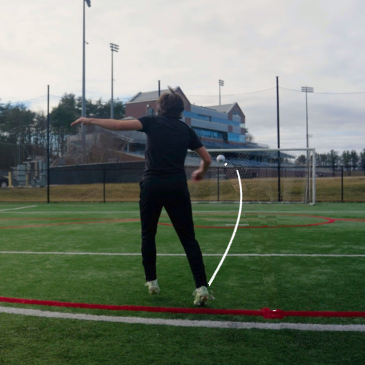
How do you bend a soccer ball?
Bend a soccer ball by applying off-center force with a firm ankle and a controlled inside-foot swing that creates sidespin. Approach at a comfortable angle, plant beside the ball and follow through naturally. In the air, that spin curves the ball. Practice the starting line and the finishing target as two separate goals.
When a bend helps
A curl can carry a pass around a defender, shape a cross into a teammate’s run or bend a free kick toward an open part of goal. The aim is useful arrival, not the biggest swerve. Sometimes a straight pass is the better choice.
A bending shot describes curved flight. Finesse describes controlled placement, often inside-foot; it need not curve dramatically. An outside-foot or trivela strike commonly creates opposite sidespin to an inside-foot strike with that foot. Learn them separately.
Contact, spin and flight
Think about two things: the part of your foot you use, and the point you hit on the ball. When your foot's force misses the ball's center, it makes the ball rotate, especially if the foot is also moving across the ball. The same impact sets the ball's starting speed and direction. Foot angle, swing path and solid contact all work together.
In flight, the spinning ball drags air around it unevenly, which pushes it sideways. That's the Magnus effect. Speed, spin and the tilt of the spin axis decide how much it bends; wind and the ball itself play a part too. More spin isn't always a better bend.
- Force direction
- The foot moves through contact, not merely to a colored spot.
- Off-center impact
- A force line away from the center can create turning force.
- Spin
- Rotation and airflow influence the flight after impact.
A typical right-foot inside-foot curl bends left from behind the kicker; a left-foot curl mirrors it. From the receiver’s viewpoint, directions reverse. Actual spin determines bend. A tilted spin axis can combine curve with dip.
Build the inside-foot bend
- Choose the route. Pick a starting line beside the final target, leaving room for curve. Use modest pace before adding power.
- Approach comfortably. Come in on a slight diagonal to give the leg room to swing.
- Plant beside the ball. Leave enough room for the striking foot, with a softly bent support knee. The support foot broadly follows the starting line. Avoid crowding the ball or twisting the planted knee.
- Make the ankle firm. Use the inside of the foot, between the big-toe joint and the instep. Don't jab with the toe.
- Swing through contact. Meet the ball with a controlled off-center force and an across-ball component. Just brushing the edge of the ball gives weak contact. Stay balanced; excessive backward lean can add unwanted height.
- Let the motion finish. Swing on across your body and let the hips turn. Never wrench the knee to force more curve. Judge the starting direction before the bend.
- Grey: comfortable approach and a support foot beside the ball.
- Lime: swing through contact without twisting the planted knee.
- Cyan: starting direction. Allow space for the later bend.
Five progressive drills
Use a clear field, soft markers and a suitable ball, with nobody in the flight path. Warm up, rest between sets and stop if anything hurts.
Drill 1:Feel the spin
- Setup & repetitions
- On clear, level grass, place a stationary ball 4–6 yards from a partner or broad collection area. Make six gentle inside-foot strikes with each foot, resetting fully.
- Measure
- Count attempts with visible repeatable rotation, separately for each foot. A partner can observe; do not guess spin speed.
- Coaching cue
- Firm ankle, contact through the ball with a small across-ball component, not a jab.
- Adapt & progress
- Younger players: 3–4 yards, age-appropriate ball, four attempts per foot. Add distance only when contact is comfortable.
Drill 2:Own the starting line
- Setup & repetitions
- Make a 2-yard gate 4–6 yards away. Strike eight balls per foot through it into open space. Ignore the final destination for this set.
- Measure
- Log gate passes out of eight and whether misses start left or right.
- Coaching cue
- Pick the launch line before approaching; spin cannot rescue a poor start.
- Adapt & progress
- Widen or move the gate closer first. Narrow it only after your starting direction becomes repeatable.
Drill 3:Gate to bend zone
- Setup & repetitions
- Keep the gate; add a 3-yard-wide finishing zone offset beyond it, 10–14 yards from the ball. Take six attempts per foot; mirror the layout as needed.
- Measure
- Score gate success and finishing-zone success separately. Count attempts achieving both, not simply visible bend.
- Coaching cue
- Start beside the target and let the curve work toward it.
- Adapt & progress
- Shorten to 6–8 yards with a larger zone for beginners. Longer flight may show more bend; do not chase power to force it.
Drill 4:Touch, then curl
- Setup & repetitions
- Take a gentle first touch into space, settle your steps, then curl toward a wide goal zone from 8–12 yards. Complete six attempts per foot without a defender.
- Measure
- Count controlled setups and target hits separately; note rushed or awkward contacts.
- Coaching cue
- Set the ball where you can swing freely, rather than reaching around it.
- Adapt & progress
- Start stationary or allow an extra settling touch. Add a slow approach only when both feet feel controlled.
Drill 5:Choose the useful bend
- Setup & repetitions
- A partner calls either a straight gate or an offset bend zone before your approach. From 10–16 yards, play eight controlled balls with each foot; no live wall or defender needed.
- Measure
- Record the right choice and target success. Compare straight and bending attempts rather than rewarding curve alone.
- Coaching cue
- Use bend when it improves the route, not on every ball.
- Adapt & progress
- Call early, shorten distance and enlarge zones for younger players. Progress to a later call, never unsafe pressure or maximum-effort volume.
Start gate: 2 yards wide, 4–6 yards away
Finish zone: 3 yards wide, 10–14 yards total distance. Red cones = initial direction; lime zone = intended arrival.
Common failures and fixes
Look for the pattern across several attempts.
- Straight flight, little spin
- Check whether the force passes too directly through the center. Try a small swing-path adjustment at gentle pace, rather than moving contact wildly sideways.
- Spin, but weak arrival
- You may be grazing the ball instead of striking through it. Use a firmer ankle and more solid contact; shorten the drill distance.
- Bend starts outside the target
- Separate launch direction from curve. Return to the starting gate and adjust foot orientation or alignment before increasing spin.
- Too high or inconsistent
- Check contact height, backward lean, bouncing balls and changing approach steps. Reset with a stationary ball and one cue at a time.
Review what happened
Log the foot, distance, gate width, target hits and starting-line misses. Keep ball, surface and conditions similar; note wind. Compare each foot with its own earlier sessions. A curved miss is still a miss.
A 20-minute practice plan
Pick a few drills rather than all of them. Rest and resets count as part of each block.
- 0–3 minWarm up with easy movement and gentle straight passes on both feet.
- 3–6 minFeel the spin: a few controlled stationary strikes, with full resets.
- 6–10 minStart-line gate: check launch direction before adding a finishing zone.
- 10–15 minGate to bend zone: count starting-line and arrival success separately.
- 15–18 minTouch then curl, or the decision drill; alternate feet and rest.
- 18–20 minEasy recovery, log results and choose one adjustment for next time.
Questions players ask
How do I bend a free kick?
Choose a safe starting line beside the target, use an angled approach and firm inside-foot contact to create sidespin, then swing through. Practice without a wall first. Height, speed, spin and the available space all affect whether the ball bends around an obstacle.
Which part of the foot makes a ball curl?
The inside of the foot, around the area between the big-toe joint and instep, is a useful starting surface. The outside can also create spin. Foot angle, swing direction and the force applied matter as much as the named surface.
Will a right-footed ball always bend left?
No. A typical inside-foot right-footed strike often bends left as viewed from behind the kicker, but the spin actually produced determines the direction. The view from the receiver reverses left and right. Outside-foot contact and different spin axes change the flight.
Can I learn with my weaker foot?
Yes. Mirror the setup, shorten the distance and compare each foot against its own previous attempts. Controlled contact and a useful starting line matter more than matching the stronger foot's power.
Why does my ball spin without much curve?
A short flight, low speed, an unsuitable spin axis or inconsistent contact can make bend hard to see. Ball construction, wind and aerodynamics also matter. Check several comparable strikes rather than assuming more spin always creates more useful curve.
Did the bend improve the arrival? That's the only test that matters. Build controlled contact, then add game pressure.